20 games · 6 cognitive skills · iPhone & iPad
Brain training games for
memory, focus
& speed
Twenty games built on classic cognitive science — dual n-back, the
Stroop test, Schulte tables, Corsi block-tapping and more. Ten minutes a day, free to play.
Free to download · no ads · sign in with Apple or Google
Memory Match Block Recall Pattern Flash Name Recall Dual N-Back Digit Span Mirror Span Stroop Go/No-Go Swarm Track Number Sprint Symbol Decode Field Scan Task Switch Rule Hunt Design Dash Mental Rotation View Point Paper Fold Path Link Memory Match Block Recall Pattern Flash Name Recall Dual N-Back Digit Span Mirror Span Stroop Go/No-Go Swarm Track Number Sprint Symbol Decode Field Scan Task Switch Rule Hunt Design Dash Mental Rotation View Point Paper Fold Path Link
The catalog
20 brain games. Six cognitive skills.
Every game trains one function and wears its colour. Memory, working memory, attention,
processing speed, mental flexibility and spatial reasoning — no filler minigames.
Short-term, visual and associative memory — pairs matching, the Corsi block-tapping test, one-flash pattern recall, and remembering names a day later.
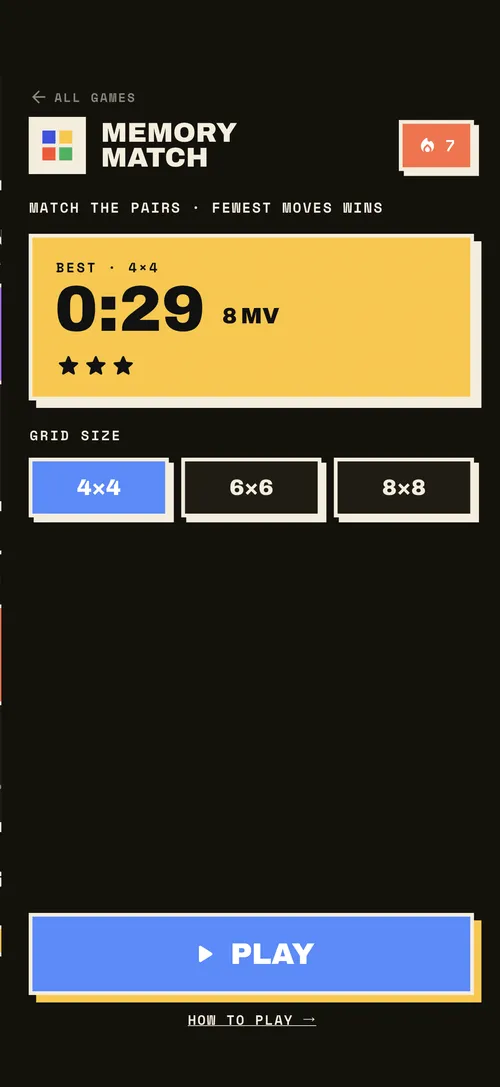
- Memory Match MATCH THE PAIRS · FEWEST MOVES WINS
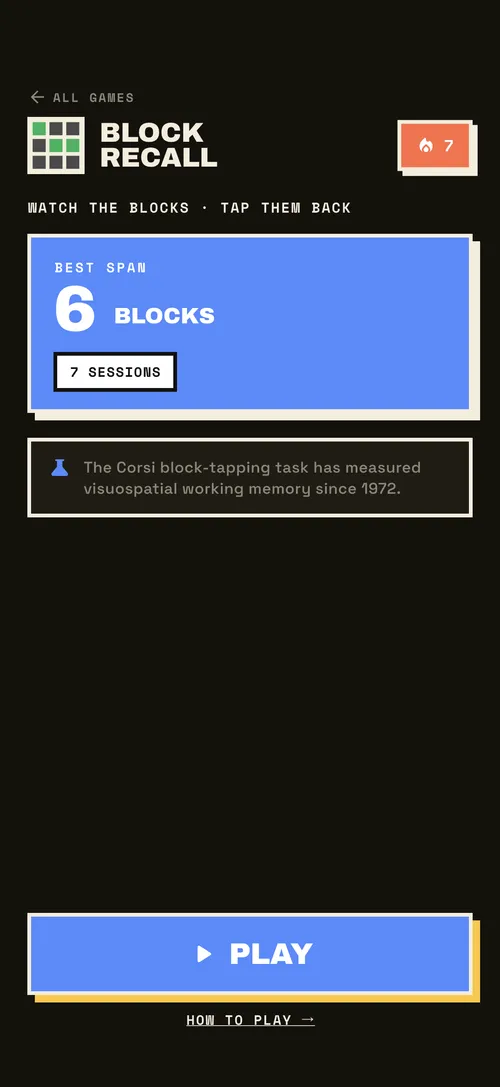
- Block Recall WATCH THE BLOCKS · TAP THEM BACK Corsi block-tapping, 1972
- Pattern Flash ONE FLASH · REBUILD THE PATTERN
- Name Recall LEARN THE FACES · RECALL THE NAMES Face-Name Associative Memory Exam
The tasks working-memory research is built on: dual n-back, the digit span test, and mirrored spatial span.
- Dual N-Back TWO STREAMS · N STEPS BACK Jaeggi protocol, 2008
- Digit Span HOLD THE DIGITS · TAP IN REVERSE WAIS classic
- Mirror Span JUDGE THE MIRROR · HOLD THE SPOTS
Inhibition and focus under pressure — the Stroop test, go/no-go response control, and multiple-object tracking.
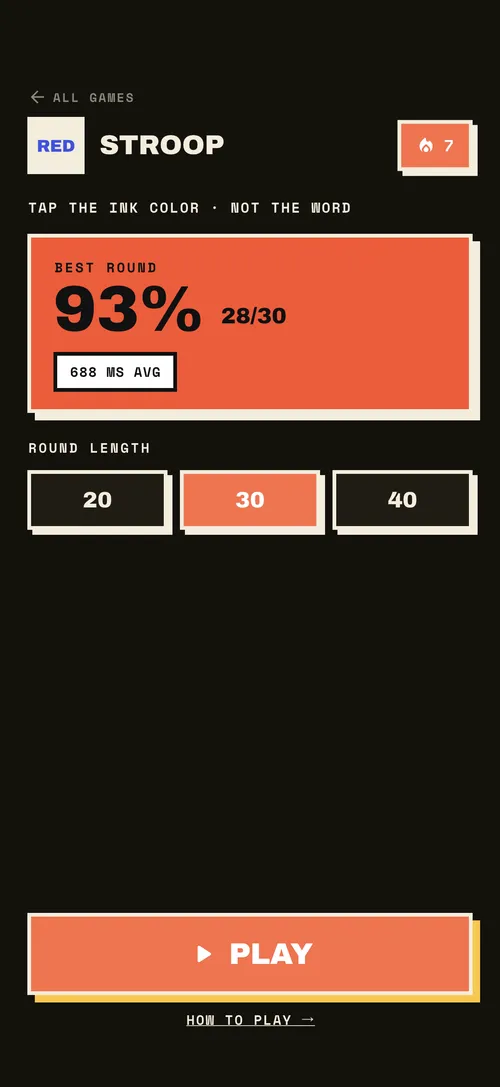
- Stroop TAP THE INK COLOR · NOT THE WORD Stroop test, 1935
- Go/No-Go TAP EVERY SHAPE · NEVER THE X Go/no-go task
- Swarm Track FLASH · ROAM · TAP THE TARGETS Multiple-object tracking
Raw speed with accuracy — Schulte table number sprints, symbol decoding, and useful-field-of-view scans.
- Number Sprint TAP 1 TO 25 · AS FAST AS YOU CAN Schulte table
- Symbol Decode DECODE THE SYMBOLS · BEAT THE CLOCK
- Field Scan CATCH BOTH · CENTER AND EDGE Useful field of view
Cognitive flexibility — switching rules mid-stream, hunting hidden rules that shift, and design fluency on a timer.
- Task Switch FOLLOW THE CUE · COLOR OR SHAPE Task switching
- Rule Hunt FIND THE HIDDEN RULE · IT SHIFTS
- Design Dash CONNECT 5 DOTS · ALTERNATE FILLED & EMPTY
Spatial reasoning — mental rotation, perspective taking, the classic paper folding test, and path planning.
- Mental Rotation SAME OR MIRRORED · SPIN THE SHAPE Shepard & Metzler, 1971
- View Point STAND · FACE · POINT TO THE TARGET
- Paper Fold FOLD · PUNCH · PICK THE UNFOLD Paper folding test
- Path Link ONE LINE · EVERY CELL · IN ORDER
The source material
Built on classic cognitive tests
These aren't invented minigames — they're the tasks cognitive psychology has used for
decades, made fast and playable.
1935 The Stroop test
John Ridley Stroop showed that reading a colour word interferes with naming its ink. Tapping the ink — not the word — trains selective attention and inhibitory control. In the app: Stroop.
1972 Corsi block-tapping
Philip Corsi’s block-tapping task is still how researchers measure visuospatial memory span. Watch the blocks light up, tap them back, one more each round. In the app: Block Recall.
2011 Face-name associative memory
The Face-Name Associative Memory Exam measures the memory that fades first with age — binding a name to a face. Learn a set, name them back, then prove it again a day later. In the app: Name Recall.
2008 Dual n-back
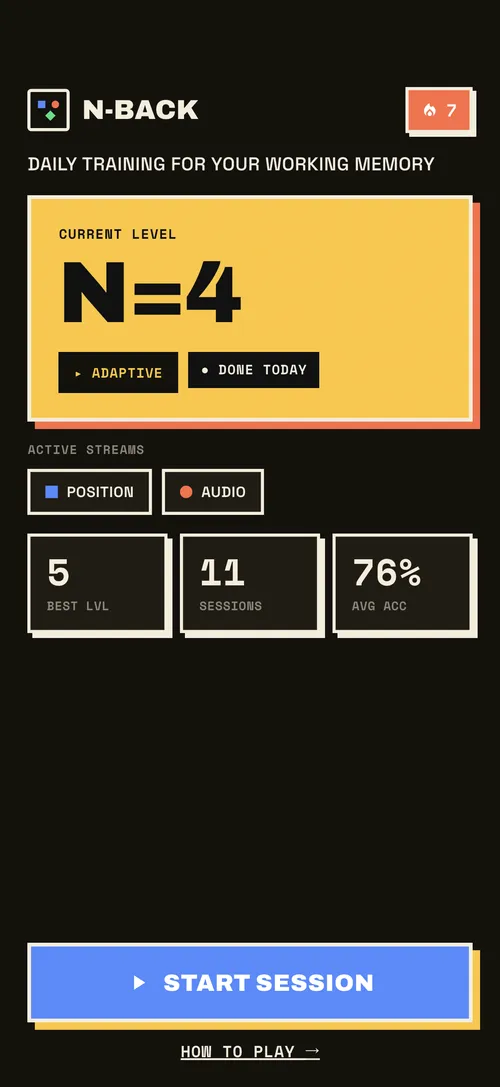
Jaeggi and colleagues made dual n-back the most-studied working-memory trainer: hold two streams in mind and match what appeared N steps back. Difficulty adapts to you. In the app: Dual N-Back.
1950s The Schulte table
Psychiatrist Walter Schulte’s scrambled number grid trains visual search speed and peripheral vision — a favourite of speed readers. Find 1 to 25 as fast as you can. In the app: Number Sprint.
WAIS Digit span
The digit span test has anchored intelligence scales for over a century: hold a growing string of digits, then recall it — hardest in reverse. In the app: Digit Span.
1988 Multiple-object tracking
Pylyshyn’s multiple-object tracking paradigm tests how many moving targets your attention can follow at once. Targets flash, roam, and hide among decoys. In the app: Swarm Track.
The honest fine print: training reliably improves the skills you practise —
your span, speed and accuracy on these tasks. Whether gains transfer broadly to everyday
intelligence is still debated in the literature, which is why Brain Games shows you real,
per-task numbers instead of a made-up "brain age".
More in the FAQ →
The habit loop
A daily workout, not a chore
DAILY WORKOUT
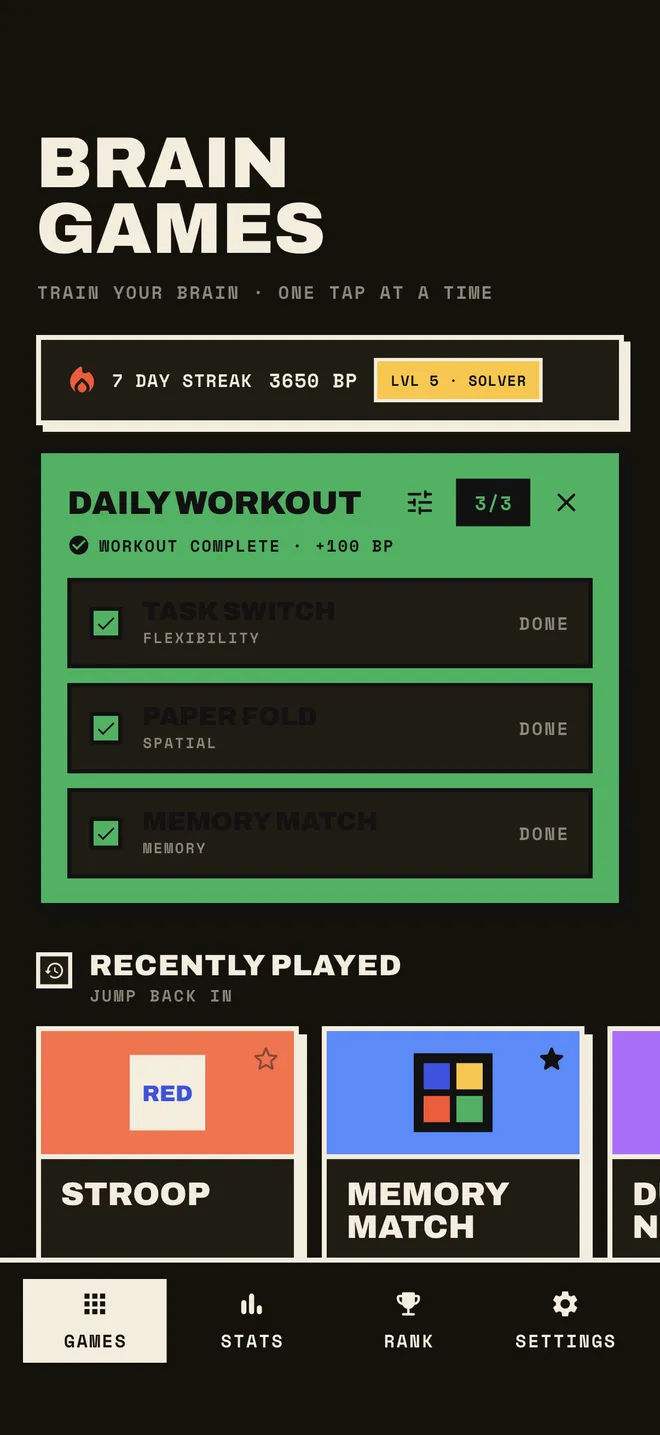
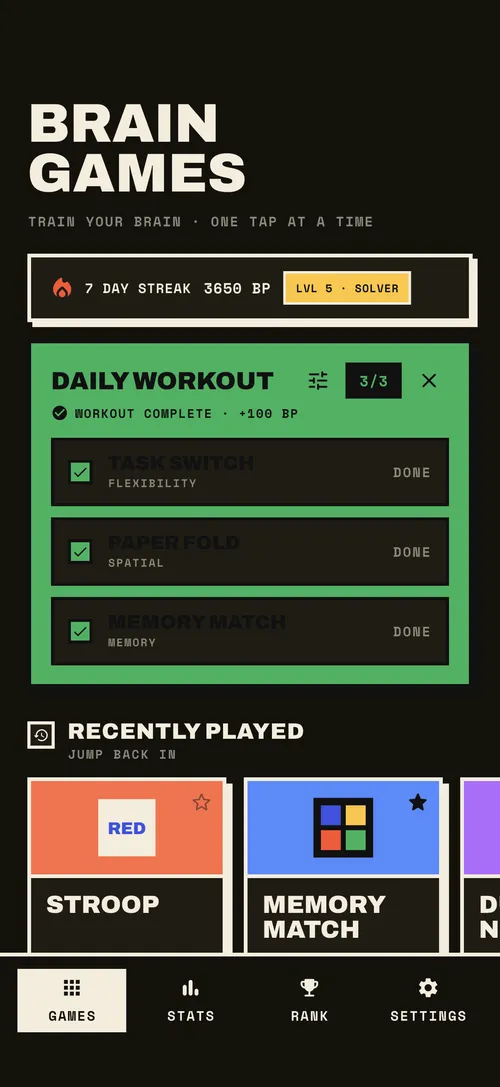
Three games from three different cognitive skills, picked fresh every day — about ten minutes. Finish all three for a +100 Brain Points bonus.
STREAKS & BRAIN POINTS
Every session earns Brain Points; a day streak multiplies them up to 1.5×. Levels and ranks — Rookie to Legend — make progress visible.
LEADERBOARDS
A global weekly board, plus points and best-score boards for every single game. Climb with a username you pick — weekly and all-time.
HONEST STATS
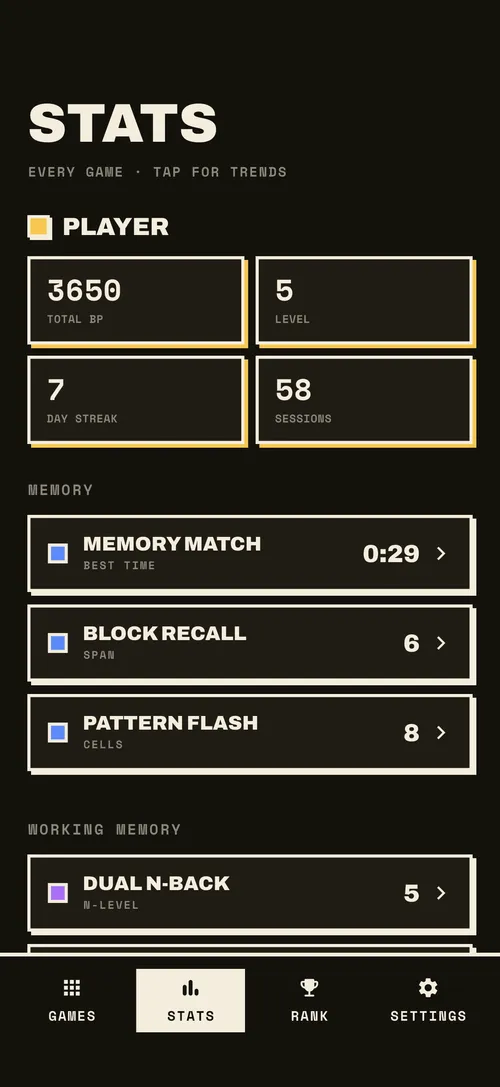
Span, accuracy, reaction time and interference cost, tracked per game. Watch the numbers researchers actually measure move over time.
Pricing
Free to play. Pro when you want more.
Free
$0 · FOREVER
- 9 games, full difficulty
- One free session of every Pro game
- Daily workout & streaks
- Brain Points, levels & ranks
- Global + per-game leaderboards
- Headline stats & personal bests
- No ads
Pro
SUBSCRIPTION · OPTIONAL
- All 20 games, including 11 advanced
- Trend charts for every game
- Big Memory Match boards (6×6, 8×8)
- Premium card packs
- Supports one-person development
Do brain training apps really work?
Practice reliably improves the skills you train — span, accuracy, reaction time. Whether that transfers broadly to everyday intelligence is still debated in the research, so we track the honest numbers and skip the miracle claims. Consistency beats intensity: ten minutes a day is the sweet spot.
Is Brain Games free?
Free to download, with 9 of the 20 games free forever — daily workout, streaks and leaderboards included, and no ads. The 11 advanced games each give you one free session; an optional Pro subscription unlocks them for good, plus trend charts, bigger Memory Match boards and premium card packs.
What is dual n-back?
A working-memory task where you track two streams at once — a position and a sound — and respond when one matches what appeared N steps earlier. The app uses the adaptive Jaeggi-style protocol: get better, and N grows.
How long is a daily workout?
About ten minutes: three short games from three different cognitive skills, rotated daily so no skill gets left behind. You can also pin your own three favourites.
Read the full FAQ
Start your streak today
Free to start · 20 games · ten minutes a day